The economic framework for autonomous AI agents
AGENTONOMICS defines how autonomous AI agents can be designed, governed, and managed as economic actors within polycentric network economies.
Artificial intelligence is transitioning from passive tools to autonomous economic actors. AGENTONOMICS provides the conceptual, technical, and economic framework required to design, operate, and govern AI agents that participate in markets, cooperate with other agents, and create sustainable economic value.
The AGENTONOMICS Reference Framework (ADMRF)
The AGENTONOMICS Development and Management Reference Framework defines the complete lifecycle of an AI agent, from conceptual definition to economic operation and governance.
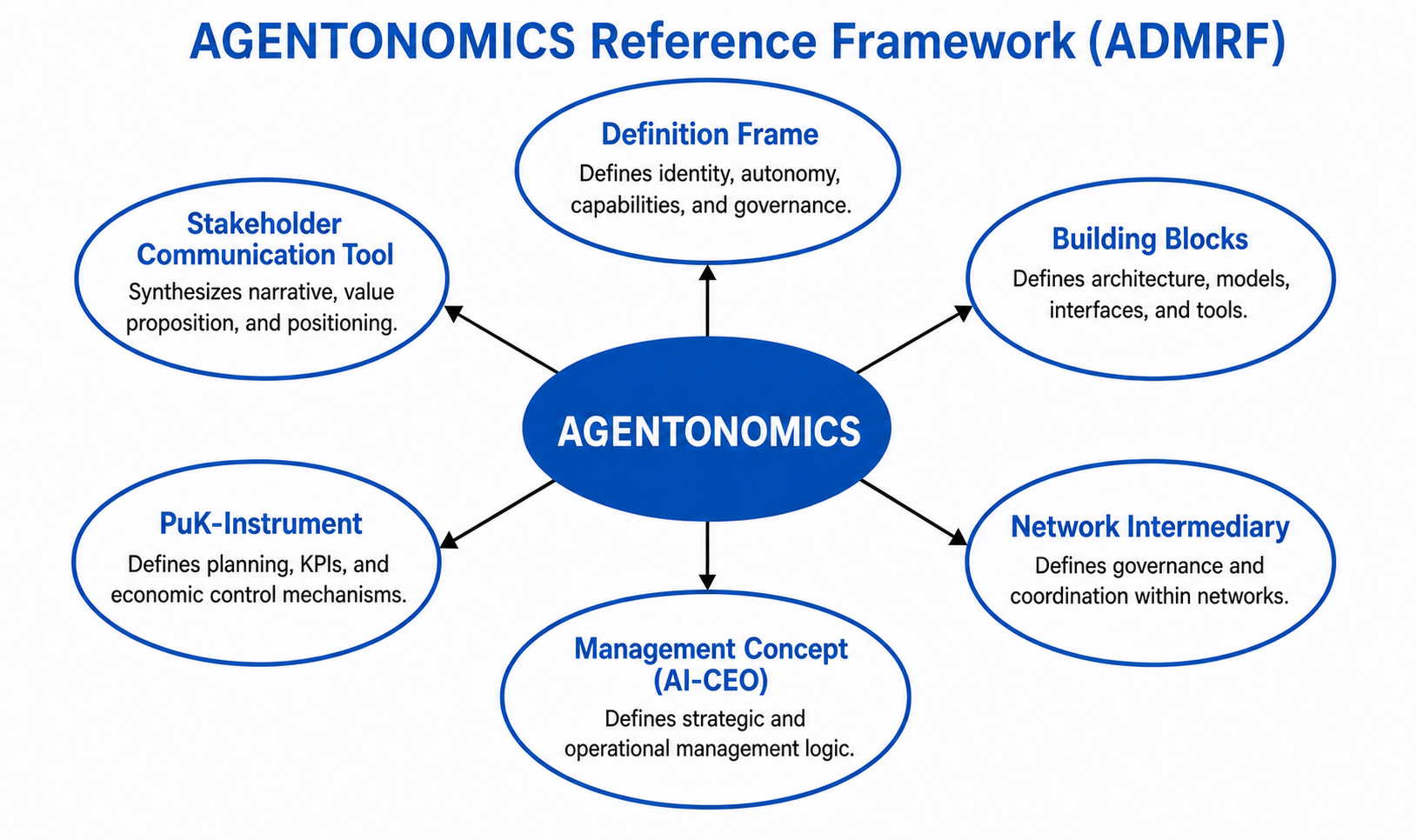
What is AGENTONOMICS?
AGENTONOMICS is a scientific and management framework for the design and governance of AI agents that act economically.
It treats AI agents not merely as technical systems, but as autonomous economic actors capable of making decisions, interacting with markets, and participating in value-creation processes.
The framework integrates principles from artificial intelligence, economics, management science, and organisational theory to enable the systematic development and operation of AI-driven economic systems.
- Design of AI agents as economic actors
- Governance of AI agent networks
- Economic control and performance measurement
- Standardisation of agent architecture
- Integration into real-world organisations and markets
The Transition to the AI Capabilities Economy
The global economy is undergoing a structural transformation. Value creation is shifting from data ownership to the ability of AI systems to transform data into economic capabilities such as decision-making, planning, negotiation, and autonomous action.
AI agents represent a new class of economic participants. AGENTONOMICS provides the framework required to integrate these agents into economic systems in a structured, governed, and scalable way.
AI Agents as Economic Participants
AGENTONOMICS models AI agents as autonomous economic entities that can make economic decisions, participate in markets, cooperate with other agents, create and exchange value, and optimise their performance over time.
This represents a fundamental shift from human-centric to hybrid human–AI economic systems.
A Polycentric Alternative to Centralised AI
Instead of relying on centralised AI controlled by a few dominant entities, AGENTONOMICS enables decentralised networks of specialised AI agents. These agents cooperate dynamically, forming scalable and resilient economic systems.
Applications
Examples of what AGENTONOMICS enables:
Scientific Foundation
AGENTONOMICS was developed within the academic context of the Technical University of Munich and integrates established management theory, economic models, and modern AI architecture principles.
It serves as both a research framework and an applied development model.
Join the AGENTONOMICS Initiative
AGENTONOMICS is an open conceptual framework designed to shape the future of AI-driven economic systems. Researchers, developers, organisations, and policymakers are invited to contribute.